How To Sell Your Design To Skeptical Clients

You know that nervous feeling just before your’e about to sell your design ideas to your clients?

It’s because you know they’re going to ask why, and you’re going to have to think up some sort of explanation. And you’re going to stutter through it with meaningless phrases: “It works because of balance” “I think this is the way to go.”

Why not instead enter the meeting with a solid argument in your back hand. To truly convince a client, nothing beats a lucid, coherent argument based on actual evidence. You may be a designer, but when it comes to pitching an idea, you have to act like a salesman.

Here are four techniques for making a good convincing sale.

1. LISTEN AND REPEAT THEIR WORDS BACK TO THEM

Sometimes, your client is trying to tell you things they don’t know how to express themselves. Your role as a designer is to pick through the subtle ties and pull out the truths they’re not being explicit about. Before you can make a valid case for any kind of solution, you need to know what the problem is. And that means listening.

Listening helps you determine what the constraints of a project really is, what the client’s concerns are. It helps you see whether or not you’ve already got the right argument in hand or if it needs looking at again.

It also helps put your client into a mindset. Repeating what you’ve heard back to the client you’re listening to is the No. 1 way to make a client feel they are being heard to the ideas you’re about to show. It shows that your forthcoming recommendations will be tightly relevant to the client’s needs.

2. ALWAYS ASK QUESTIONS CONTINIOUSLY

A good designer should ask questions—about the business, they’re concerns, they’re needs, they’re prior decisions, they’re team and goals. A great designer wants to see the whole picture.

They ask questions because they’re really curious. They ask questions because the answers can help them see what they’re getting into. They ask questions because they want to work toward a vision they can use to make good design decision. Asking questions lets them do that.

Asking questions lets a designer form a coherent debate. Asking is as important as listening. It’s actually part of listening. Asking means dragging more information out into the spotlight.

Next time you walk into an interview, ask questions. Next time you need to make an informed decision ask questions. Next time you need to fend off a bad idea, someone’s bias, your own bias, ask questions.

3. PATIENTLY EXPLAIN YOUR REASONING

A client asked me to add “click here” to a link. They were worried users wouldn’t know what I meant for them to click—the link was a question like “Forgot password?” I explained the reasons for not including “Click here.”

We all know it takes time to explain things like this. That email took 15 minutes to write.

But it’s worth it. It buys you respect, and it shows your client respect. What they hear is that you care enough to explain your rationale. It also demonstrates that you have a rationale for everything you do. It can build trust.

Educating your clients and co-workers and stakeholders with every recommendation you make has effective effects:

  • It guarantees you have a reason for your recommendation.
  • It gives everyone a good reason for the recommendation.
  • It has a long-term effect: It teaches clients to think about design. To think like a designer. To think like a consumer. It teaches them that every decision has an impact on a user’s experience and therefore should be considered. Do this well, and over time you won’t need to form an argument for your reasoning.

4. PRESENT YOUR RATIONALE LIKE AN ESSAY

If you can present your case and do it at the start, you won’t need to argue. Your narrative will address every concern before it comes up.

It helps to apply an essay-style structure to your presentation. When you’re presenting design work to someone, that essay can be helpful. It’s a template. Its tells a story.

Here’s one tip for how to keep an audience captive while you’re making your rationale.

A lot of times, your audience, especially smaller ones will want to ask questions during the presentation. This is fine if it’s a minor question with a quick answer. There is no quicker way to derail your argument than to let something like this distract you and leave everyone forgetting what you were hoping to achieve.

The tip is simple: Ask your customers to hold their questions until the end of the presentation.

In many examples, especially if you’ve anticipated their concerns, you’ll have already answered most of the big questions. This doesn’t mean you’re done. It’s practically a guarantee that someone will ask you something you haven’t yet thought of. This is why the questions are at the end.

If you let these things throw you off track in the middle of a presentation, you may never answer the other important questions. If your meeting is an hour, leave 5-10 minutes at the end for questions.

Whatever the case, leave some time. Questions are the only way you’ll know what you’ve missed.

In Summary: It can always be a tough sell to convince your’e client your reasons for why you design a project the way you do. Steve Jobs put it so well “The customer is always right was told by the customer”. People don’t know what they want, you need to show them. Believe in what you do and why you do it. Remember customers come to you because they can’t do it themselves.

Selling Your Design Value

Design-Value-DesignLab=Adelaide


As design agencies face more and more competition in selling their design services, they are now looking to areas where they can add design value for clients (and get paid for that added value).

For years now advertising / marketing gurus speak about something called USP (unique selling proposition). This has based on assumptions that an area of a product / service could have a unique resonance with a particular market demographic.

Value proposition – what is it?

Value proposition is the promise of a value to be delivered to a client. True value proposition works when the receiver of the value (client) has acknowledged that they have received value from the product or service.

A value proposition can apply to an any organisation, products or services.

Preparing value proposition is part of a business strategy.  Strategy is based on a differentiated customer value proposition. Satisfying customers is the source of sustainable value creation.

Design value proposition – what is it?

A design value proposition is written from a working analysis of your client and your competitors. From these you can identify what value design can add to your clients’ business. Value that you know your competitor don’t offer.

The design value proposition has three important key statements.

  1. The areas that a client values.
  2. How a designer can offer services to enhance and communicate the value to customers
  3. Example of success that the designer has had in project with a peer.

Design value proposition – how to use it?

The design value proposition is not a statement you put on your website, however it does guide your submission and pitches to clients. Its structure is the structure you use in pitches. You begin by showing the client you understand what it is they value. Then you outline a strategy for your services to communicate the value to customers. You may also show a strategy to enhance the value through design. The submission would finish with a budget and projected return on investment based on a similar project.

Value pricing

In any resignation, price your service on the value they generate for your client, not the number of hours it will take.
Your design value proposition needs to show the value of your service that can return for the client and now you’re asking for a part of that increased value.

It does requires trust and confidence

As stated above in the value proposition definition it has to require the client to acknowledge the added value. This is only possible if the client respects and trusts the designer…i.e. you!

What is Good Graphic Design?

To understand and know what good graphic design is or know why some designs work and others don’t you need to know about the basic elements and principles of design.

Elements of Design Lines, Colour, Type, Imagery, Texture Lines are used to direct the eye and create forms. Basically, lines are found in layouts to separate content, such as in magazine, newspaper, and websites.

Colour is an important element in design, it can be used to make an image stand out, to evoke emotion.

Type, is all around us. In graphic design, the goal is to not to just place some text on a page, but rather to use it effectively for communication. Choice of fonts (typefaces), size, alignment, color, and spacing all come into play.

Imagery (Art, Illustration & Photography) A powerful image can make or break a design. Photographs, illustrations and artwork are used to tell stories, support ideas, and grab the audience’s attention. Texture refers to the actual surface of a design or to the visual appearance of a design. In the first case, the audience can actually feel the texture, making it unique from the other elements of design.

Principles of Design The principles of design apply to any piece you may create. How you apply those principles determines how effective your design is in conveying the desired message and how attractive it appears. When designing a piece ask yourself the following questions:

Balance, Proximity, Alignment, Repetition, Contrast, Space

Balance
Visual balance comes from arranging elements on the page so that no one section is heavier than the other. Are your page elements all over the place? does each portion of the page balance out the rest?

Proximity
Closeness creates a bond between elements on a page. How close together or far apart elements are placed suggests a relationship (or lack of) between the information, i.e. Are title elements together? Is contact information all in one place?

Alignment
Brings order to chaos. How you align type and graphics on a page and in relation to each other can make your layout easier or more difficult to read. Is there a common alignment — top, bottom, left, right, or centered — between blocks of text and graphics on the page?

Repetition
Repeating design elements and consistent use of type and graphics styles within a document shows a reader where to go and helps them navigate your designs and layouts safely. i.e. do page numbers appear in the same location from page to page? Are major and minor headlines consistent in size, style, or placement? Have you used a consistent graphic or illustration style throughout?

Contrast
Helps different design elements stand out. Is there enough contrast between your text (size and color) and background (color and pattern) to keep text readable? Is everthing all the same size even when some elements are more important than others?

Space
Designs that try to cram too much text and graphics onto the page are uncomfortable and may be impossible to read. White space gives your design breathing room. Do you have enough space between columns of text? Does text run into graphics?

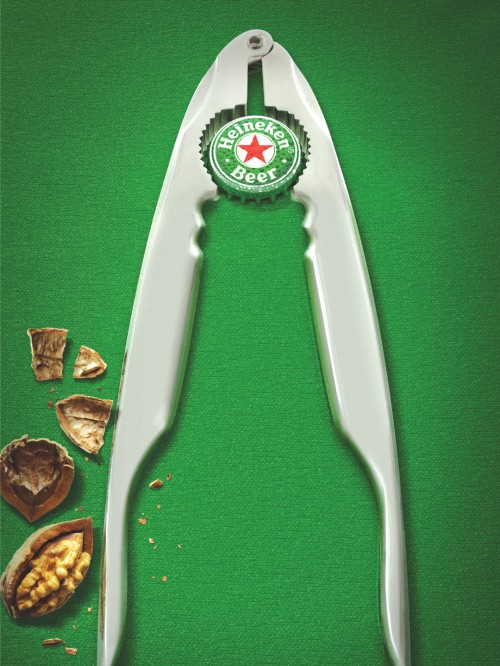
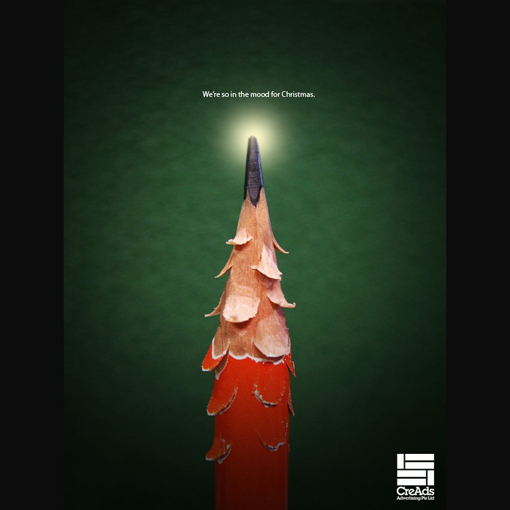
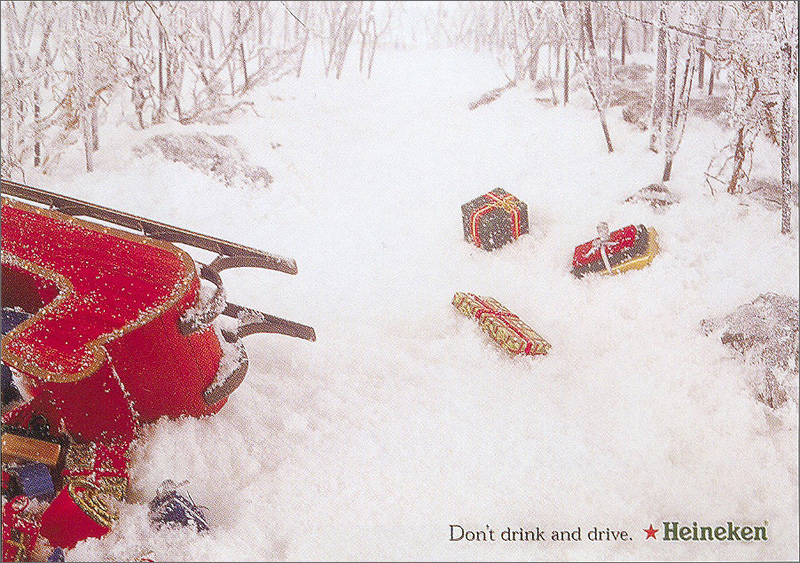
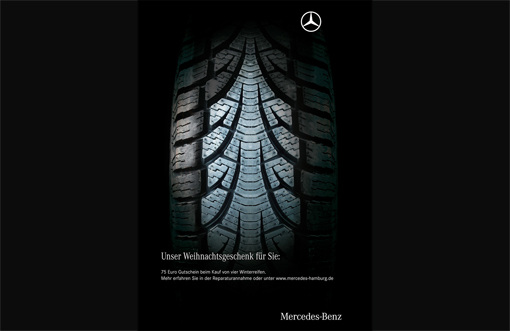
Some good Christmas Design Ads

Christmas is upon us yet again. We are all likely rushing around like a crazy people this week trying to get all your work done, finish up your Christmas shopping, preparing to travel, etc. Every year, we are asked by our loving clients to design them something for Christmas i.e. cards, e-cards, newsletters, Facebook banners and more, and every year we strive to design something different from your normal tinsel, red & green backgrounds with snow flakes and cursive typography. It’s just boring as bat shit! So we took some time out from our hectic graphic design schedule and took a look at some inspirational Christmas design that actually looks and feel different.

Let’s take a minute to slow down and absorb some solid Christmas design inspirations.

Some of these ads will make you laugh, others might earn an approving nod or even a roll of the eyes. All are definitely worth a look and are sure to get your brain in a creative mode.
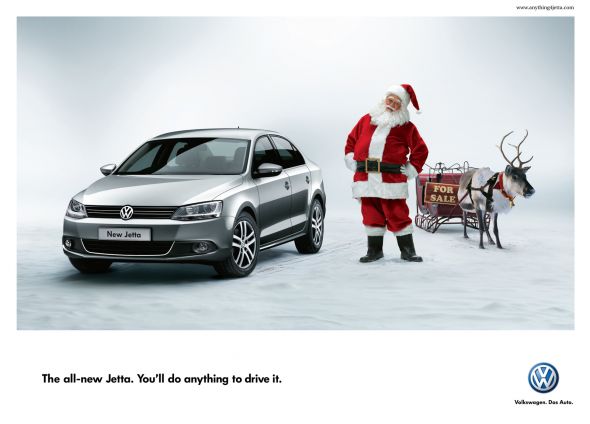
jetta_santa.preview mcdonalds_christmas_fries santa-nike xmas-10 xmas-design_apple xmas-design_construction xmas-design_hp xmas-design_sillon xmas-design- xmas-design-heineken xmas-design-mercedes-2 xmas-design-mercedes xmas-design-pepsi xmas-inbev


Have a Great Holiday!

Whether you celebrate Christmas, Hanukkah or Festivus, we here at DesignLab would like to wish you a very happy holiday season.